
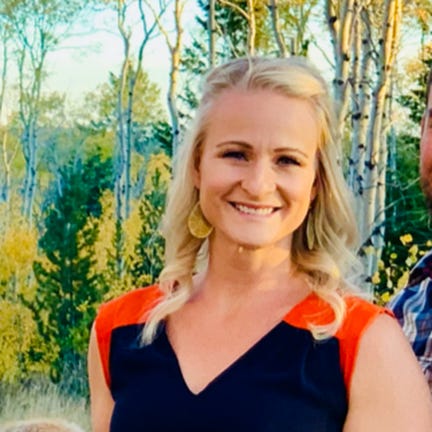
Faith Howard is a 6-12th grade literacy specialist in Pinedale, Wyoming.
What did your Science of Reading or Science of Learning journey look like, and how did they intersect?
My background is actually as a high school English teacher. My degree is in secondary education and English, and when I think back to those formative years, I realize I was never taught how to teach kids how to read. I wasn’t taught how kids learn to read, or how our brains process reading—let alone ever hearing the term "science of reading" in undergrad or even in my master’s program, which is really unfortunate.
I have a master’s in curriculum and instruction, with an emphasis in English, and even then, the focus was on helping students analyze texts and dig deep into meaning—which is amazing and valuable—but I never learned about the foundational skills necessary for reading.
That gap really hit me when I was in the classroom. I always had this nagging feeling as a high school English teacher, because I had students who were clearly not reading at grade level. I’d listen to them read aloud and feel really sad about the lack of fluency and their struggle to decode multisyllabic words. Many of them couldn’t comprehend higher-level texts or didn’t have a strong working vocabulary.
But as an English teacher, I didn’t have the tools or training to address that. I supported them the best I could—I used scaffolding, explicit instruction, all of those solid instructional practices—but I wasn’t targeting the foundational gaps. I simply hadn’t been taught how.
Then, about three years ago, everything changed. My school district received a CLSD (Comprehensive Literacy State Development) grant, and they created a position for a high school literacy specialist. There were specialists in the other buildings as well. I applied, even though I felt totally unqualified. I just thought, “I’m passionate about helping struggling readers, so I’ll give it a shot.”
To my surprise, the hiring team said I was by far the most qualified person—and honestly, I didn’t understand how that could be true. But they gave me the job and told me, “If you can dream it, you can do it.”
So here I was, stepping into a role where I was expected to intervene with high schoolers who were significantly behind in reading—without a clear roadmap. I was overwhelmed, scared, and really unsure of what to do. So, I turned to research. I started reading everything I could: books, articles, journals, listening to podcasts—just immersing myself in all of it.
That’s when I really discovered the science of reading. One of the first places I encountered it was through the Institute for Multi-Sensory Education (IMSE) Morphology Plus training. They have an introduction that lays out the science of reading and the Orton-Gillingham approach, and it completely lit a fire in me.
Once I grasped what the science of reading really was, it just clicked. I couldn’t believe this information wasn’t more widely accessible—especially to high school teachers, English teachers, social studies teachers, and really any secondary educators. It’s so vital.
So for me, the past three years have been a huge learning curve. But discovering the science of reading—and being able to tie my interventions and instruction directly to its key components—has been transformational. Without it, I would have kept doing the same things, and my students wouldn’t have made the progress they did.
What are 3 effective practices you use in your classroom?
A lot of my students have significant gaps, particularly in their understanding of phonics, and that’s common for many high school and middle school students who are reading below grade level. So, we start by teaching the six syllable types. Then, we move into this daily decoding routine, which gives them lots of repetition and practice.
One of the biggest roadblocks for struggling secondary readers is their inability to decode unfamiliar words—typically multisyllabic words that haven’t been orthographically mapped. As students get older, they encounter more of these kinds of words, and without strategies, they get stuck.
The decoding strategy we use has been incredibly rewarding. It’s amazing to see the moment when it clicks—when a student lights up and says, “I just decoded a word I would have mumbled through or skipped over before.” It’s really powerful. And the best part is, it doesn’t take a ton of time. It can be done as a “Do Now” at the beginning of a lesson.
Another key piece of what I do is heavy incorporation of morphology instruction. This past year, I experimented with combining morphology and explicit vocabulary instruction into one routine. I used to teach them separately—first the morphemes, then the vocabulary—but it clicked one day: If I’m introducing new vocabulary, why not teach the morphemes within those words at the same time?
So, I developed an explicit instruction routine where students learn vocabulary words that include the morphemes we’re studying. For example, in the spring, I taught Just Mercy in my high school literacy lab. There were so many justice-related terms—big legal words like incarceration and adjudicated. We broke those down into roots, prefixes, and suffixes, and then expanded to other related words.
The repeated exposure and integration really deepened their understanding. That combined vocabulary and morphology routine—along with engaging visuals, activities, and mini whiteboards—really ignited their word consciousness.
I’d say my third strategy is more about lesson structure and instructional design. Years ago, I was trained in Teach Like a Champion, and I still use many of those core techniques. I apply them when I structure and chunk my lessons, especially during novel studies.
Here’s what a typical class might look like:
We start with a “Do Now,” which is usually an oral reading fluency routine.
Then, we move into a hook, followed by lesson framing.
Instruction follows an “I do, we do, you do” format with built-in checks for understanding.
We wrap up with an exit ticket or a mastery check.
That kind of structure has continued to provide the consistency students need. One specific piece I’m especially proud of is the oral reading fluency routine I’ve developed over the last two years. It’s a daily progression from Monday to Friday using repeated reading. Each day has a specific task.
Weekly Oral Reading Fluency Routine
Multisyllabic Monday:
Students partner-read a new, unfamiliar informational text (related thematically to our novel). Before reading, they pick a multisyllabic word they’re unsure about. They go through our decoding steps and then check the word with me—segmenting and blending it correctly.Transfer Tuesday:
Students select a vocabulary word with familiar morphemes and complete an activity, usually a word sum, where they break it into parts and define each to determine the full meaning.Writing Wednesday: Focuses on sentence-level writing. Students examine sentences from the text, rewrite them, and eventually build up to writing their paragraphs. We work on syntax and structure—skills that are critically needed.
Thinking Thursday:
Students respond to a discussion or annotation prompt. They manipulate the text and then process it verbally with a peer, applying their thinking to the novel we’re reading.Phonics Friday or Fluency Friday: On Phonics Friday, students do encoding work. I pull multisyllabic words from the week’s text, and they sound them out and try to spell them correctly—really working through the sounds and letter combinations.
On Fluency Friday, they assess their partners on prosody using a rubric—evaluating expression, pacing, and intonation—and give each other feedback.
All of these routines—decoding, morphology, vocabulary, and fluency—have been truly transformational for my students. They’re structured, progressive, and engaging. Most importantly, they meet students where they are and help move them forward in meaningful ways.
What type of professional learning is most effective for you and why?
I’m a practitioner’s practitioner. I really value professional development that’s grounded in real classroom experience. There’s definitely a place for PD delivered by researchers or people who are a bit removed from the day-to-day of teaching—but for me, the most beneficial kind is the kind led by active teachers.
I want to learn from educators who are in the classroom, trying strategies in real time, and then sharing what actually works. That’s part of why I signed up for the Goyon Fellowship. I loved the idea of learning from others who are essentially doing action research—testing methods, filming their lessons, and showing student work. That kind of PD resonates deeply with me because I can immediately envision myself doing it in my classroom.
When I’m learning from theory alone, there’s often a mental gap. You have to do a lot of extra metacognitive work to figure out how to translate that theory into practice—and that can be a multi-step process. But when I see someone doing the work in the classroom, it just clicks faster.
And honestly, I’m kind of old school. I love hands-on, in-person professional development. It’s always been my favorite. I’m a bit of a nerd and a lifelong learner—I just genuinely love learning. So, whether it’s virtual or in-person, I’m all in for PD.
How do you try to pay your knowledge/learning forward so others can benefit?
In the state of Wyoming, I’ve tried to become the kind of educator I was just talking about—the kind I’ve personally benefited from: teachers sharing with teachers.
I’m working to be that person, not just here in my state, but potentially on a national level as well. There’s a huge need for secondary literacy resources, as you know from participating in PAL. We need more models of intervention that actually work for older students.
So, for me, I created a literacy lab class, and we’re now seeing incredible results—this is our third year, and the data shows it’s not a fluke. It’s working.
Because of that, the best thing I can do is share it—whenever and wherever I can. I participate in professional development opportunities, speak at conferences, and join educator networks where I have a platform to share this work. For example, at the Embracing Literacy Conference here in Wyoming this past June, I led a session where I walked attendees through a format and structure for lesson planning. I brought a folder filled with sample lesson plans, videos, and materials—including templates—all shared freely.
To me, it’s about amplifying the impact by giving teachers a leg up. I have so much empathy because three years ago, I was that teacher who didn’t know where to start or what to do. So if I can help someone who's now in the position I was then, I will.
Just recently, I heard from a literacy research center that runs after-school programs. They implemented my lesson structure and materials during a six-week summer program—and they reported incredible gains with their students. That kind of feedback is really encouraging.
Ultimately, that’s what it’s all about: sharing ideas, supporting one another, and collaborating. That’s how we move the science of reading forward in secondary education spaces.
What has led you to your success in your classroom or at your school?
I think I already touched on this earlier, so I won’t be too long-winded here—but really, the way this all came about feels kind of serendipitous.
Me becoming a literacy specialist after all these years—it wasn’t part of some grand plan. It happened out of sheer desperation. I didn’t know how to do this work at first. I had to learn everything from the ground up. Then I built this literacy lab class, and the success it's had with students is really what brought me to where I am now.
If I hadn’t learned these things… if I hadn’t created this class model… or if it hadn’t been successful, I don’t think I’d be here having this conversation. But I think the most important point to highlight is this:
Support from school leadership is critical.
School leaders have to wake up and realize that there are middle and high school students—17-year-olds—reading at a fifth-grade level. And if we don’t intervene, we’re running out of time.
I’ve been incredibly fortunate in my district to have administrators who are literacy champions. They’ve trusted me, given me the autonomy to innovate and create this model, and carved out time and space in our school schedule to run these intervention classes. That support has been everything.
One of the most common things I hear from teachers trying to get something similar off the ground is: “We don’t have the time built in.” And my first response is always:
You need to go to your administrators. You have to educate them about the science of reading, show them the student data, and help them see the urgency. Once their eyes are open—and once you have their support—that’s when real change becomes possible in your school.
Faith’s contact:
Email: literacylabwithfaith@gmail.com