

Lately, the term linguistic phonics, known as “speech to print”, has been popping up all over the place. It certainly has on Substack. Don’t get me wrong, I’m an advocate for using linguistic phonics with our students, in particular the Evidence-Based Literacy Instruction known as EBLI, but linguistic phonics is not the next new and shiny object in education. Those of us talking about it today stand on the shoulders of those who developed this approach over many long years.
Why Choose Linguistic Phonics?
I adopted EBLI about two years ago. I had been using traditional structured literacy approaches, but my kids were taking too long to learn the code. I’m a reading interventionist, and by the time students come to me for support, they are already light-years behind their classmates. They didn’t have any time to waste. I adopted EBLI because I heard it might help accelerate my students. I’ve kept using it because it lived up to that promise. You can see some of those results in this post.
A Concrete Example
Last Thursday, I met with a second grader, who is not on my caseload. She has been taught using a print-to-speech intervention. She successfully learned her letter sounds and learned to blend CVC words. Her nonsense word CBMs have been steadily rising, but she hasn’t been explicitly taught the rest of the code.
Session 1: I showed her two of the most important tenets in linguistic phonics: One sound can be spelled with up to four graphemes, and a grapheme can have more than one sound. Then, we moved on. I showed her in one compact lesson how the letter e at the end of words works, and we read several words. If you’re thinking this sounds the same so far, here’s the difference. Ordinarily, this concept takes between 5-10 days because most curricula teach each vowel separately. That’s a lot of days for a concept I can teach in 5-10 minutes, and then spend our time practicing with texts.
Once the student understood, we moved on to a sound sort with long e spellings. I taught her six ways to spell long e (ee, ea, ie, y, e, and i). Some she must have been familiar with since she read the word beach, but others, like “y” or “ie” or even “ee” were new to her.
Session 2: The following day, we reviewed reading and spelling VCe words and moved on to our first authentic text cycle. This is where I taught the EBLI multisyllabic word spelling and reading routine. We spelled words such as “beautiful” and “decided”, not just one-syllable words like “tree,” “see,” or “beach.” These activities have a corrective feedback routine, and students are asked to spell by syllable, segment sounds, make corrections, and practice. Everything about it is explicit, challenging, and extremely motivating. Although encoding is part of every solid program, EBLI does not limit student learning to only one-syllable words. Students do not need to graduate to multisyllabic words. Multisyllabic words are addressed right from the beginning of instruction.
Next, we moved on to multisyllabic reading. The words I used for practice came from our first text. Some words had some of the long e spellings, but some did not. The words are all chosen because of their impact on the text. These were words like scientist, finally, similar, human, and nutrients.
Once we learned how to thread syllables together and read these longer words, we moved on. The first text we read was an article from Readworks called “When Trees Get Thirsty.” I chose this article because it presented a lot of information to discuss and dissect, opportunities to practice reading some words with long e spellings, and I knew there would be several multisyllabic words this child would encounter. These are all considered learning opportunities.
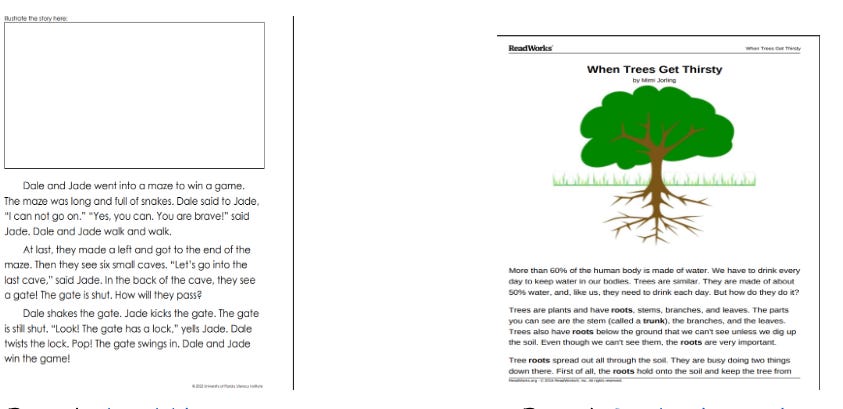
Example decodable passage Example Readworks article
When I read text with students, I use a fluency routine called Read, Read Back, Read Again. While reading, I also take an opportunity to check for understanding, making sure the child understands the text. In one of the early sentences, trees are being compared to humans because we both need to drink. This gave the child an opportunity to explain the concept of similarity. This type of comprehension work, as well as multisyllabic decoding work, would not occur in decodable texts. That isn’t what they were meant for.
Now, I realize, not everyone will stand behind the instruction I’ve described here, but by the end of day 2, this student read the first couple of sections of this text with complete understanding and fluency. She was able to practice reading words with long e spellings like “tree” and “thirsty.” She encountered words such as “like” and “made,” and she worked her way through words like “similar” and “important.” This student will also use her newly acquired knowledge to write a gist statement explaining how water moves through trees.
The Outcome
In just two days, this student’s knowledge has grown exponentially. She applied her learning and even surprised me with some of the words she read.
So what is my point?
My point is this: we could wait longer to teach students r-controlled vowels, or we could support children in encountering those phonics patterns much earlier. I could use only decodables and limit the patterns this child encounters, or I could use an authentic text, like an article, where this student has an opportunity to work on multiple skills with guidance and support. In both types of instruction, the learner is taught new phonemes or graphemes and is shown how to read words; however, the level at which students are asked to apply their learning is more rigorous in authentic texts.
Accelerated learning and progress is just that. I won’t need to teach this child every pattern in the code, but I will teach her enough code so she can read. Statistical learning will kick in at times, and she will reach what Mark Seidenberg calls “escape velocity.” In the meantime, I can guarantee she will be reading pieces like the tree text successfully, and we will move on to learning six spellings of the long vowel a.
Within the next three months of school, this child will move through the code at an accelerated rate and will catch up to her peers. After just our second session, she was so engrossed in the text that we didn’t even realize the next group of students had already walked into my room.
Some educators might wonder what this does to a student’s psyche. I watched the glimmer in her eye grow as she sounded out words like “important” and “scientist.” She previously hadn’t known she could read those words. In those moments, a light bulb goes off.
Linguistic phonics will not save education. Reading is a complex process with many intricacies and nuances, but it can provide students with access to learn the code sooner and get on the ramp to reading authentic texts. This, in turn, provides opportunities for effortful thinking and discussion.
It is not enough to say we use structured literacy approaches or we no longer use ineffective practices. Advocating for best practice and for children means we are willing to explore the possibility that we can learn and grow our instruction and, frankly, do better. The shifts I made moving from traditional phonics instruction to linguistics phonics were not huge leaps; they were alternative ways of thinking. What’s at stake are the many children sitting right in front of us and those who came before them, whom the educational system failed to help. Highlighting the commonalities and differences in approaches helps the educational community move forward and have open conversations that will help pinpoint the most effective and efficient way to teach children to read.
My son learned to read using a S2P approach. There is no question in my mind that it is the fastest way to get children on the road to reading and close gaps. Excellent post! When we know better, we must do better!
Fantastic results and fast! So impressed by your article. Thank you for sharing this perspective. Also enjoyed your positive attitude about making CHANGE:" The shifts I made moving from traditional phonics instruction to linguistics phonics were not huge leaps; they were alternative ways of thinking."